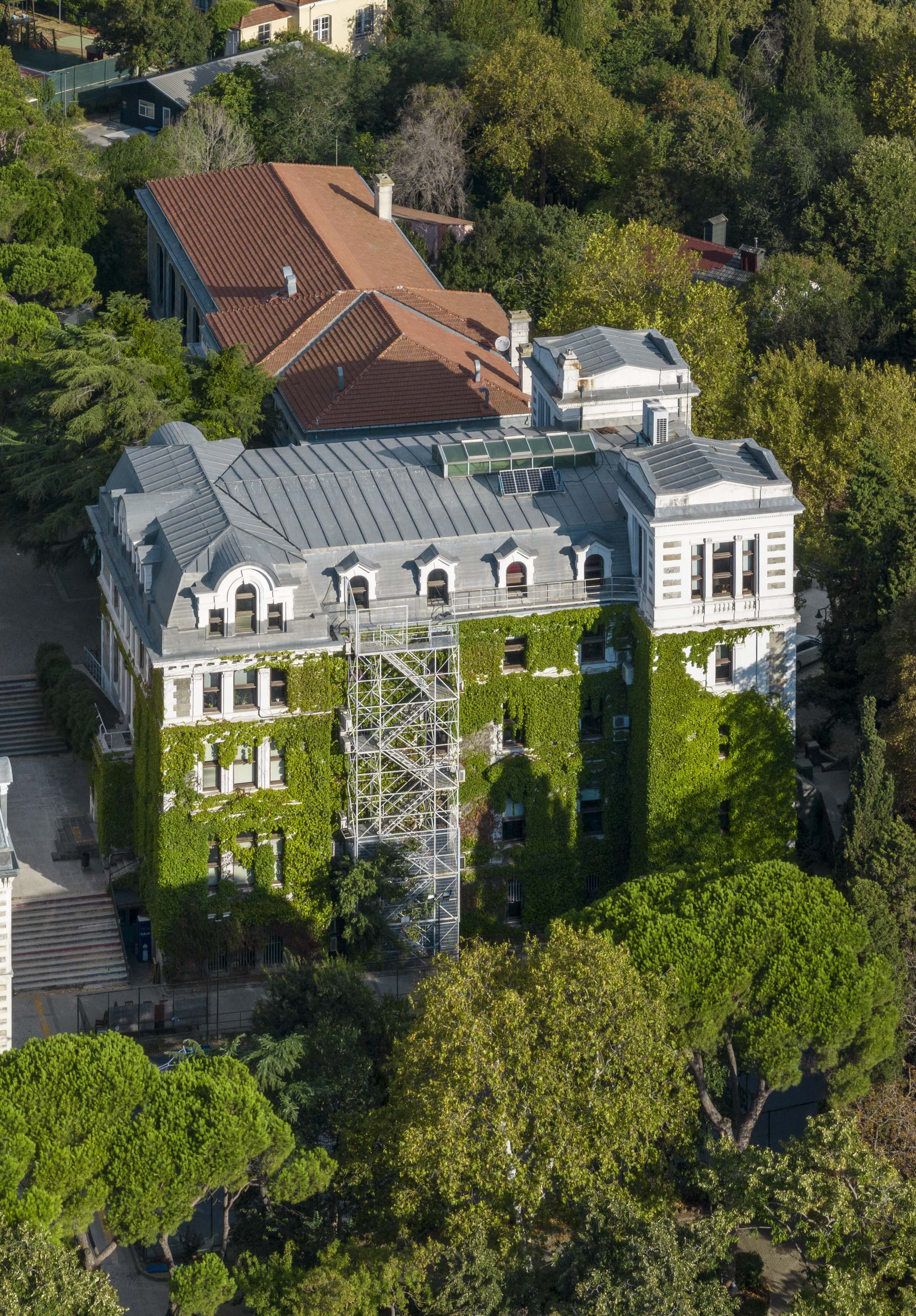



Deprem Mühendisliği Ana Bilim Dalı
Öğrenim:
- 2003-2007: Ortak Doktora, Yer Bilimleri
Ecole Normale Supérieure, Laboratoire de Géologie, Paris, - 2000-2007: Doktora, Deprem Mühendisliği
Boğaziçi Üniversitesi, Kandilli Rasathanesi ve Deprem Araştırma Enstitüsü, Deprem Mühendisliği Ana Bilim Dalı - 1994-1997: Yüksek Lisans, Deprem Mühendisliği
Boğaziçi Üniversitesi, Kandilli Rasathanesi ve Deprem Araştırma Enstitüsü, Deprem Mühendisliği Ana Bilim Dalı - 1989-1994: Lisans, İnşaat Mühendisliği
Boğaziçi Üniversitesi, İnşaat Mühendisliği Bölümü
Deneyim:
- 2013-devam Yardımcı Doçent Dr., Boğaziçi Üniversitesi, Kandilli Rasathanesi ve Deprem Araştırma Enstitüsü, Deprem Mühendisliği Ana Bilim Dalı
- 2000-2008 Araştırma Görevlisi, Boğaziçi Üniversitesi, Kandilli Rasathanesi ve Deprem Araştırma Enstitüsü, Deprem Mühendisliği Ana Bilim Dalı
- 2007-2008 Yarı Zamanlı Araştırmacı, Avrupa Komisyonu Projesi, FP6, Network of Research Infrastructures for European Seismology (NERIES), 2006-2010,
- 1998-1999 AGF Hayat Garanti Sigorta, Sağlık Departmanı Sorumlusu
- 1996-1999 AGF Garanti Sigorta, Proje Yönetimi ve Yönetim Bilişim Sistemleri
- 1994-1996 Araştırma Görevlisi, Boğaziçi Üniversitesi, Kandilli Rasathanesi ve Deprem Araştırma Enstitüsü, Deprem Mühendisliği Ana Bilim Dalı
Araştırma Alanları:
- Deprem Tehlike ve Risklerinin Belirlenmesi
- Deprem Kaynaklı Tehlikeler için Mikrobölgeleme
- Kuvvetli Yer Hareketi Simülasyonu
Uluslararası Hakemli Dergilerde Yayımlanan Makaleler
- Erdik M., Sesetyan K., Demircioglu M., Hancilar U., Zulfikar C., Durukal E., Kamer Y., Yendogan C., Tuzun C., Cagnan Z. and Harmandar E., Acta Geophysica, Special Issue IGRS, “Rapid Earthquake Hazard and Loss Assessment for Euro-Mediterranean Region” (submitted)
- Sesetyan K., Zulfikar C., Demircioglu M.B., Hancilar U., Kamer Y., and Erdik M., Soil Dynamics and Earthquake Engineering, Special Issue Earthquake Early Warning, “Istanbul Earthquake Rapid Response System: Methods and Practices” (submitted)
- Erdik M., Sesetyan K., Demircioglu M.B., Hancilar U., and Zulfikar C. Soil Dynamics and Earthquake Engineering, Special Issue Earthquake Early Warning, “Rapid Earthquake Loss Assessment After Damaging Earthquakes” (submitted)
- Çağnan, Z., K. Şeşetyan, C. Zülfikar, M.B. Demircioğlu, Ç. Kariptaş, E. Durukal, and M. Erdik (2008) “Development of Earthquake Loss Map for Europe”, Journal of Earthquake Engineering, Vol: 12S2.
- Strasser, F.O., J.J. Bommer, K. Şeşetyan, M. Erdik, Z. Çağnan, J: Irizarry, X. Goula, A. Lucantoni, F. Sabetta, I.E. Bal, H. Crowley, and C. Lindholm (2008) “A Comparative Study of European Loss Estimation Tools for a Scenario in Istanbul”, Journal of Earthquake Engineering, Vol: 12S2.
- M.Erdik, M.B. Demircioglu, K. Sesetyan, E. Durukal and B. Siyahi (2004) “Earthquake Hazard in Marmara Region, Turkey” Soil Dynamics and Earthquake Engineering, Vol: 24, pp. 605-631.
- M. Erdik, N. Aydinoglu, Y. Fahjan, K. Sesetyan, M.B. Demircioglu, B. Siyahi, E. Durukal, C. Ozbey, Y. Biro, H. Akman and O. Yuzugullu (2003) “Earthquake Risk Assessment for Istanbul Metropolitan Area”, Earthquake Engineering and Engineering Vibration, Vol.2 No.1.
- Erdik et al. (2003) “Earthquake Risk Assessment for Istanbul Metropolitan Area” Boğaziçi University Press, 300 pages.
- Erdik, M., E. Durukal, B.Siyahi, Y. Fahjan, K. Şeşetyan, M. Demircioğlu, H. Akman, (2003), Risk Mitigation in Istanbul”, Chapter 7, Earthquake Science and Seismic Risk Reduction, Ed. by F. Mulargia and R.J. Geller.
- Erdik,M., Y. Biro, T. Onur, K. Sesetyan and G. Birgoren (1999) “Assessment of earthquake hazard in Turkey and neighboring regions”, Annali Di Geofisica, Vol. 42 N.6, pp. 1125-1138.
- Papers published in Conference Proceedings
- Erdik, M.; Cagnan, Z.; Zulfikar, C.; Sesetyan, K.; Demircioglu, M. B.; Durukal, E.; Kariptas, C. (2008), Development of Rapid Earthquake Loss Assessment Methodologies for Euro-MED Region. Proc., 14. World Conference on Earthquake Engrg., Paper ID: S04-004
- Demircioglu, M.B., K.Sesetyan, E.Durukal and M.Erdik (2007) “Assessment of Earthquake Hazard in Turkey” Proceedings of the 4th International Conference on Earthquake Geotechnical Engineering, June 2007, Thessaloniki, Greece
- Durukal, E., M. Erdik, K. Şeşetyan and Y. Fahjan (2006) “Building Loss Estimation for Earthquake Insurance Pricing”, Proceedings of the 8th US National Conference in Earthquake Engineering, 16-20 April, 2006, San Francisco, US.
- Durukal, E., M. Erdik, K. Şeşetyan (2006) “Expected Earthquake Losses to Buildings in Istanbul and Implications for the Performance of the Turkish Catastrophe Insurance Pool” Proceedings of 2006 ECI Conference on Geohazards, Lillehammer, Norway
- A.Ansal, K.Özaydın, M.Erdik, M.Yıldırım, H.Kılıç, Ş.Adatepe, P.T.Özener, M.Tonaroğlu, K.Şeşetyan, M.Demircioğlu (2005) “Seismic Microzonation for Urban Planning And Vulnerability Assessment” Proceedings of the International Symposium of Earthquake Engineering (ISEE2005), Awaji
COURSE OBJECTIVES : Assessment of seismic hazard, meaning the computation of the levels of specific ground motion parameters that are likely to occur at a site, is one the key components in all seismic risk mitigation activities. The areas of applicability vary from the assessment of design basis ground motions corresponding to different performance levels for the aseismic design of individual structures to regional scale assessments for seismic design code requirements as well as for all earthquake risk mitigation activities. Although it is known that earthquake occurrences are governed by the physics of the earth, a large amount of uncertainties are involved in the chain of estimations from the occurrence of the event to the level of ground motion that will be experienced at a specific site. In this course, the approaches and methodologies for the assessment of the seismic hazard at a single construction site or at regional scale will be taught. The objective of the course is to give to the engineer the capability of conducting a site specific PSHA/DSHA study and to interpret and use the results.
COURSE SYLLABUS : The first lectures will be devoted to introduction of general concepts, the background physical information on earthquake occurrences and the main approaches used in the assessment of seismic hazard. The core of the lecture will be dedicated to the step-by-step evaluation and modelling of each ingredient in the seismic hazard assessment, which will be combined in the final model. The course will make use of different freely available seismic hazard assessment software defining their areas of applicability together with their advantages and disadvantages. Case studies will be conducted to assess sensitivity of the results to different models and parameters used. Finally an introduction will be made to design basis ground motion concept as well as the accompanying time history selection and scaling procedures.
PREREQUISITES : EQE 400 or EQE 520 are suggested
DURATION & HOURS PER WEEK : 3 hrs per week / 3+0+0
GRADING BASIS : Reports and take home exam
REFERENCE TEXTBOOKS : Articles from scientific journals
COURSE OBJECTIVES : Earthquake Engineering can be defined as the branch of engineering devoted to mitigating earthquake hazard. In this broad sense, earthquake engineering covers the investigation and solution of the problems created by damaging earthquakes, and consequently the work involved in the practical application of these solutions, i.e. in planning, designing, constructing and managing earthquake-resistant structures and facilities. The objective of the course is to make the student familiar with the concepts and methods in the multidisciplinary field of earthquake engineering.The course will be dedicated to the understanding of earthquake phenomena, the causes of earthquakes, the effects of earthquakes on the nature, on man-made structures, and on the community in general. Basic concepts and principles of earthquake engineering will be taught and a general idea of the various disciplines of earthquake engineering will be given.
COURSE SYLLABUS :
PREREQUISITES :
DURATION & HOURS PER WEEK : 3 hrs per week / 3+0+0
GRADING BASIS :
REFERENCE TEXTBOOKS :
Başarı ve Ödüller
Scholarship of the French Embassy in Turkey for joint PhD studies between Turkish and French Institutions
