


Geotechnical Earthquake Engineering Laboratory
Geotechnical Earthquake Engineering Research Center Laboratory (GEERCL) was established in 2021 at Boğaziçi University Kandilli Campus Science and Technology (BTK) Building with the support of the “Geotechnical Earthquake Engineering Research Center (GEERCL) Project” coded 2021K12-168856 of the Presidency of Strategy and Budget of the Republic of Turkey.
In order to be able to estimate the effects of earthquakes on the ground surface realistically, the soil properties must be determined accurately. With the infrastructure under development of GEERCL, dynamic experiments are carried out simultaneously in both laboratory and field environments. With the field test vehicle “Mobile Seismic Shaker (MSS)” developed within the scope of this project, it is possible to determine and evaluate the seismic behavior of the ground in a realistic way in the field environment. The shear wave velocity profile of the field is determined with MASW (Multi-Channel Analysis of Surface Waves).
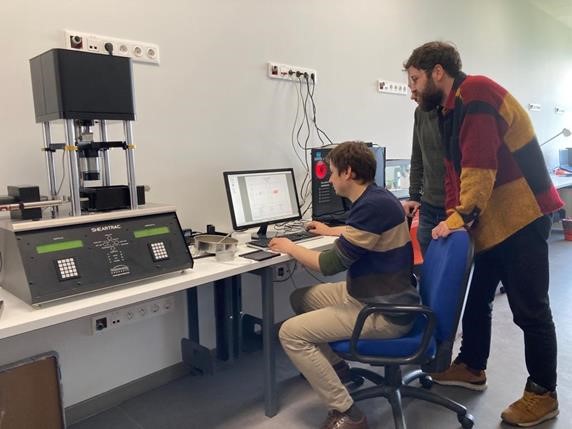
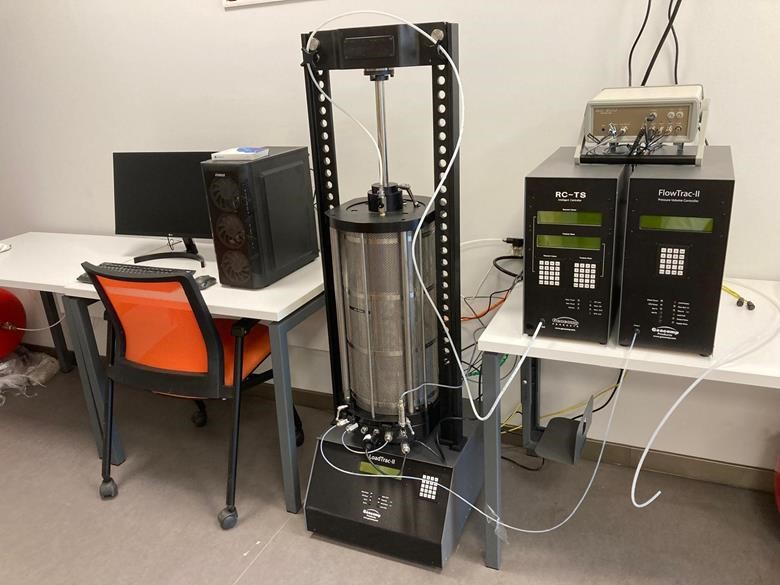
In the Geotechnical Earthquake Engineering Research Center Laboratory; soil classification tests, determination of liquefaction potential of soils (sieve analysis, Atterberg limit tests, determination of water content), determination of dynamic soil properties with Dynamic Simple Shear Test System (DBKDS) in the high strain range and “Resonant Column and Torsional Shear System (RKBKS)” in the low strain range, and “Bender element test” are carried out.
With Dynamic Simple Shear Test System (DBKDS), soils are tested at high shear strain amplitudes and the shear modulus and damping ratio of the soil are found. In addition, liquefaction and soil improvement tests are carried out with the test system. With “Resonant Column and Torsional Shear System (RKBKS)”, the shear modulus and material damping ratio of soils and rocks are measured in the high strain levels. Depending on the hardness of the soil in torsional shear mode, the shear modulus and damping ratio can be determined up to 10% shear strain. Dynamic soil properties in resonant column tests are evaluated at the resonance frequency of the sample. In addition, the small strain shear modulus of the soil is found with the “Bender Element” test.
GDMAML has an experimental infrastructure for determining soil-based earthquake effects, especially liquefaction, in earthquake zones in our country and for improving local soils. Actively operating at GDMAML, experimental studies are carried out for education, training and research purposes and new researchers are trained in the study subjects.